
Stop fighting your brain. Start winning.
53 tips to stick to your diet, be more productive and excel in life, drawn from 542 scientific references. Stop fighting against your brain, and learn to work with it in the way it understands.

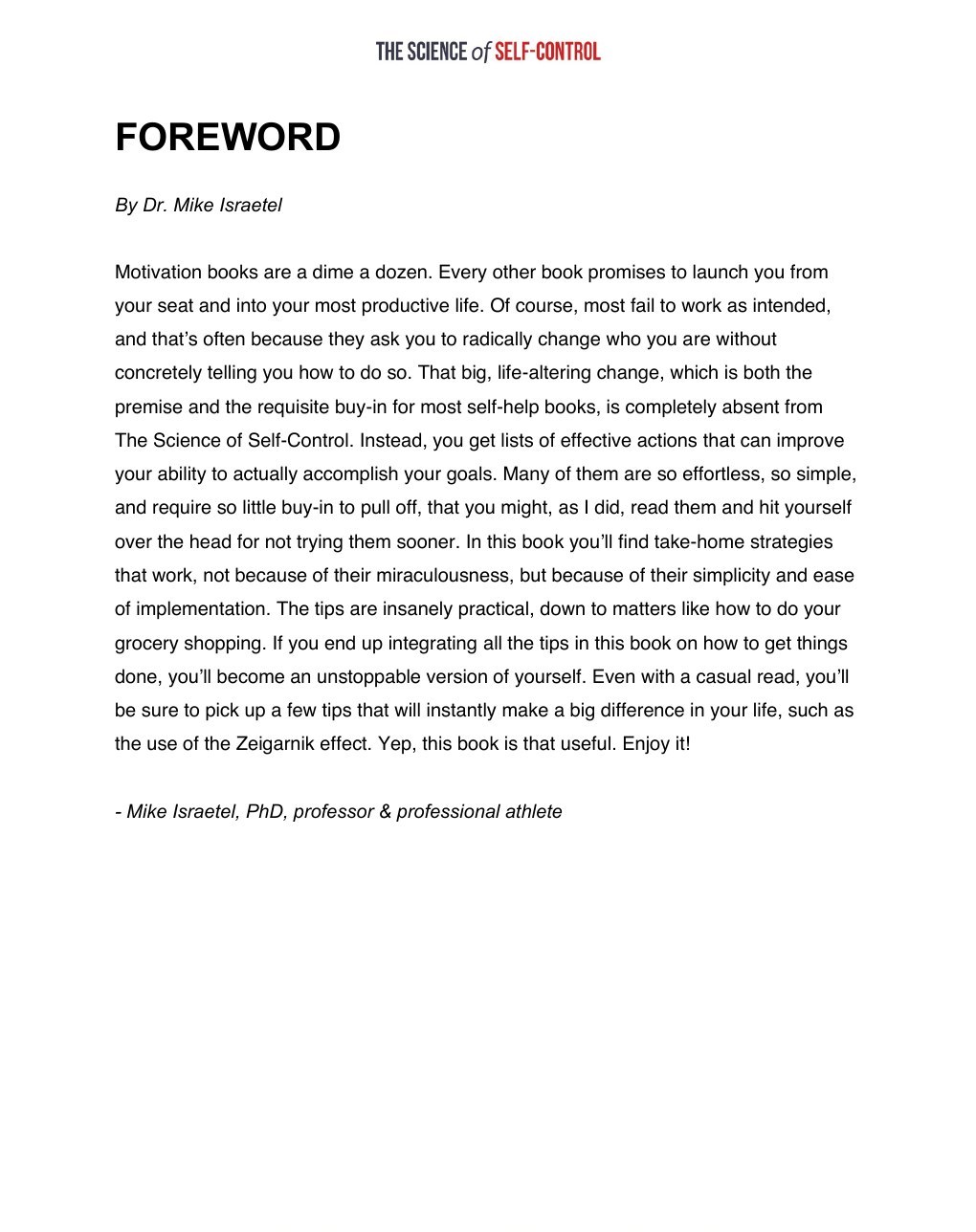
If you end up integrating all the tips in this book on how to get things done, you'll become an unstoppable version of yourself.
Dr. Mike Israetel, co-founder of Renaissance PeriodizationEbook and audiobook $9.99 $4.99 until 30 November





It's Sunday night, and this week is going to be different
You'll meal prep on Monday. You'll finally finish that important work project. You'll start the workout routine you've been meaning to do for months. And you'll stop mindlessly scrolling on your phone.
But then you blink and it's Wednesday. You're ordering takeout, procrastinating on Instagram, and wondering what's wrong with you.
I have good news and bad news. The bad news is you lack self-control. The good news is you're human. My goal with this book is to make you superhuman.
- They start every Monday with the best intentions.
- They download productivity apps and make detailed plans.
- They promise themselves "just this once".
- They feel motivated after reading success stories.
- They beat themselves up for "lacking willpower".
Your brain isn't designed for the modern world
For thousands of years, humans survived by seeking immediate rewards and avoiding immediate threats. Our brains evolved to grab food when it was available, rest when we could, and avoid anything that required unnecessary effort.
But now you're supposed to resist the donut, work on boring spreadsheets for hours, and exercise instead of watching Netflix. You're trying to fight millions of years of evolution, so it's no wonder you can't win.
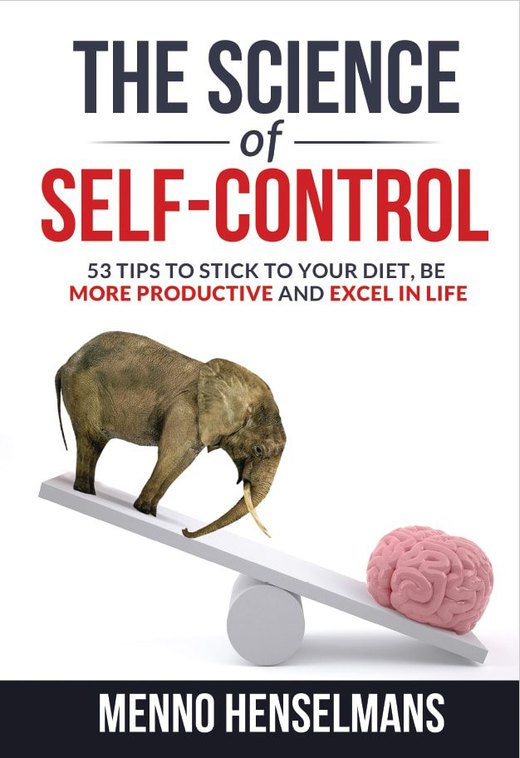
That's why, to win, you have to stop fighting against your brain, and work with it in the way that it understands.
Your impulsive system
Fast, automatic and built for the savanna. It wants the reward now and the effort never.
Your rational system
Slow and deliberate, the part that holds your goals. The book teaches you to get them on the same side.
53 concrete, science-backed strategies
Not vague advice like "be more positive". Concrete tools, drawn from cognitive neuroscience and behavioral psychology.
Why willpower keeps failing you
- The "nocebo effect" secretly sabotaging your efforts
- Why "trying harder" can actually make things worse
- How to develop a will that never breaks
How to become unstoppably productive
- The 90-minute attention rule elite performers swear by
- Why multitasking destroys your brain, and what to do instead
- The "implementation intention" that doubles follow-through
How to stick to any diet without suffering
- Why mental energy has nothing to do with physical energy
- The "umami preload" strategy that improves self-control
- Why flexible control beats rigid dieting every time
How to make exercise feel effortless
- Why training more frequently reduces perceived effort
- How to use caffeine strategically without building tolerance
- Why heavy weights are actually less effortful than light ones
How to build motivation that never runs out
- The growth mindset that separates achievers from everyone else
- How to cultivate competence, autonomy and relatedness
- How purpose can make discipline unnecessary
Plus 38 more strategies
- From optimal sleep timing to grocery shopping psychology
- Even how to write your grocery list (yes, it matters)
- Every one backed by peer-reviewed research
Read the first pages
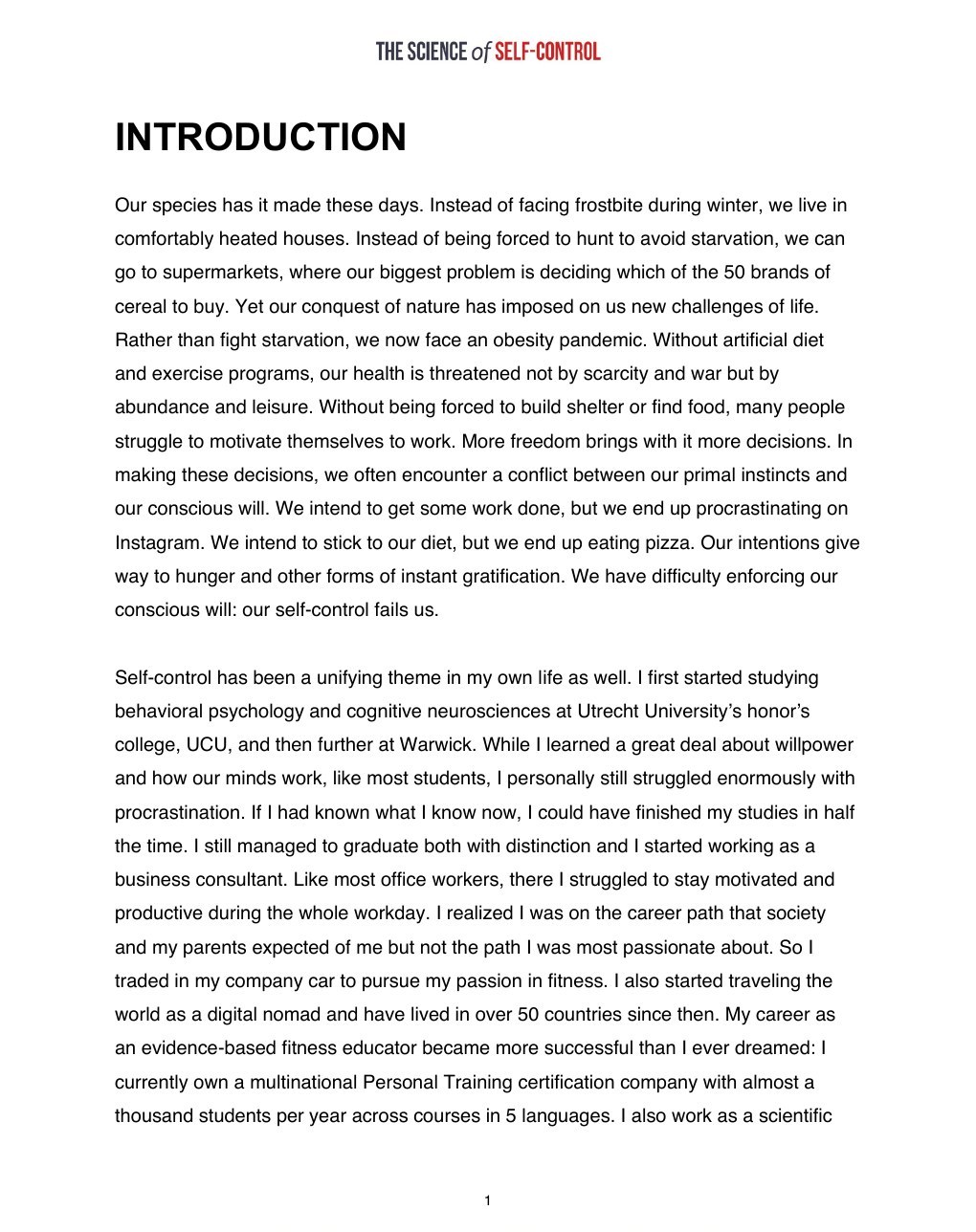
Turn the pages just like you would in store. This is exactly how the book opens, no sign-up needed.
Introduction
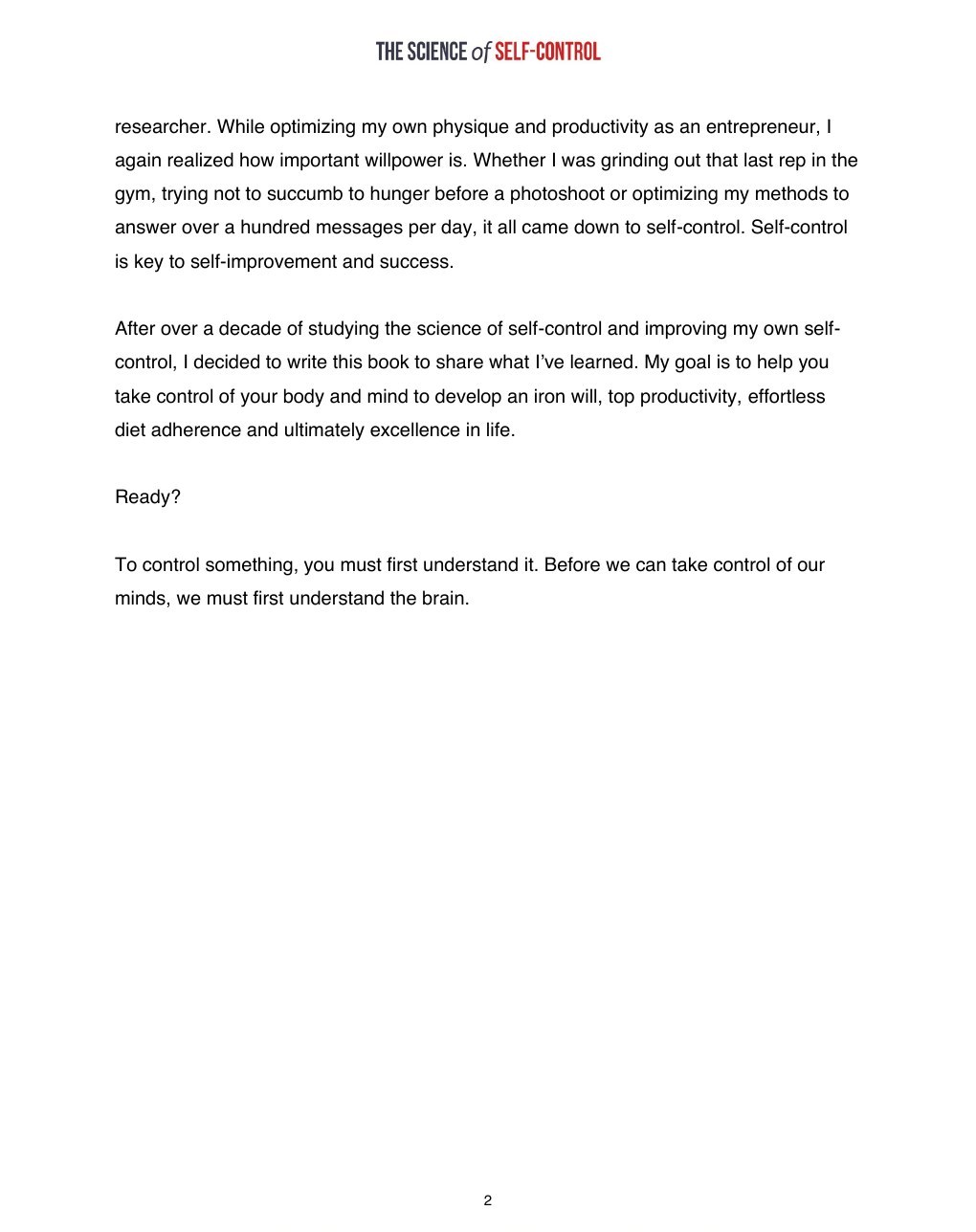
Our species has it made these days. Instead of facing frostbite during winter, we live in comfortably heated houses. Instead of being forced to hunt to avoid starvation, we can go to supermarkets, where our biggest problem is deciding which of the 50 brands of cereal to buy. Yet our conquest of nature has imposed on us new challenges of life. Rather than fight starvation, we now face an obesity pandemic. Without artificial diet and exercise programs, our health is threatened not by scarcity and war but by abundance and leisure.
Without being forced to build shelter or find food, many people struggle to motivate themselves to work. More freedom brings with it more decisions. In making these decisions, we often encounter a conflict between our primal instincts and our conscious will. We intend to get some work done, but we end up procrastinating on Instagram. We intend to stick to our diet, but we end up eating pizza. Our intentions give way to hunger and other forms of instant gratification. We have difficulty enforcing our conscious will: our self-control fails us.
Chapter 1: 2-System Theory
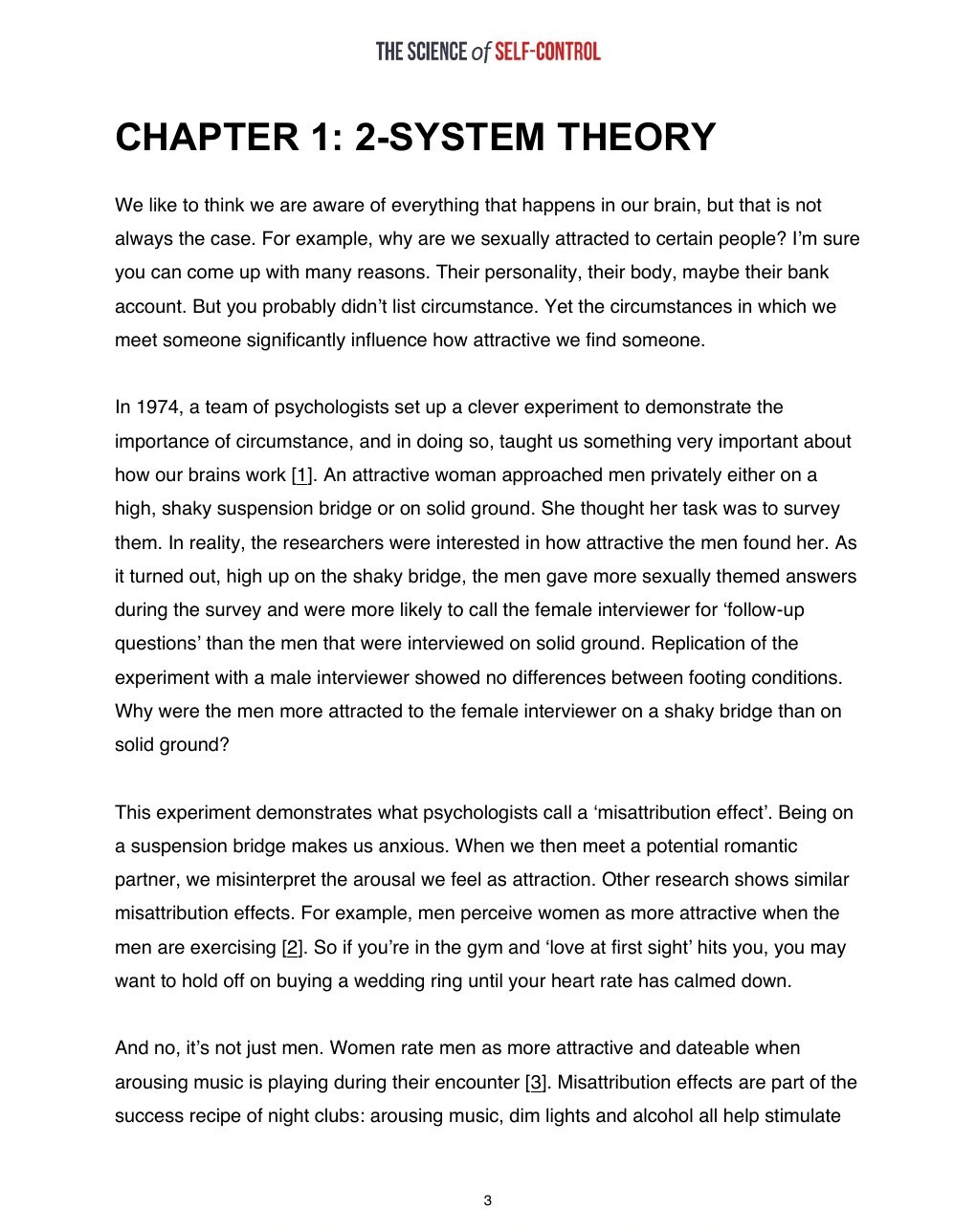
We like to think we are aware of everything that happens in our brain, but that is not always the case. For example, why are we sexually attracted to certain people? I’m sure you can come up with many reasons. Their personality, their body, maybe their bank account. But you probably didn’t list circumstance. Yet the circumstances in which we meet someone significantly influence how attractive we find someone.
In 1974, a team of psychologists set up a clever experiment to demonstrate the importance of circumstance, and in doing so, taught us something very important about how our brains work. An attractive woman approached men privately either on a high, shaky suspension bridge or on solid ground. She thought her task was to survey them. In reality, the researchers were interested in how attractive the men found her. As it turned out, high up on the shaky bridge, the men gave more sexually themed answers during the survey and were more likely to call the female interviewer for ‘follow-up questions’ than the men that were interviewed on solid ground. Replication of the experiment with a male interviewer showed no differences between footing conditions.
This experiment demonstrates what psychologists call a ‘misattribution effect’. Being on a suspension bridge makes us anxious. When we then meet a potential romantic partner, we misinterpret the arousal we feel as attraction.
Every chapter, every tip
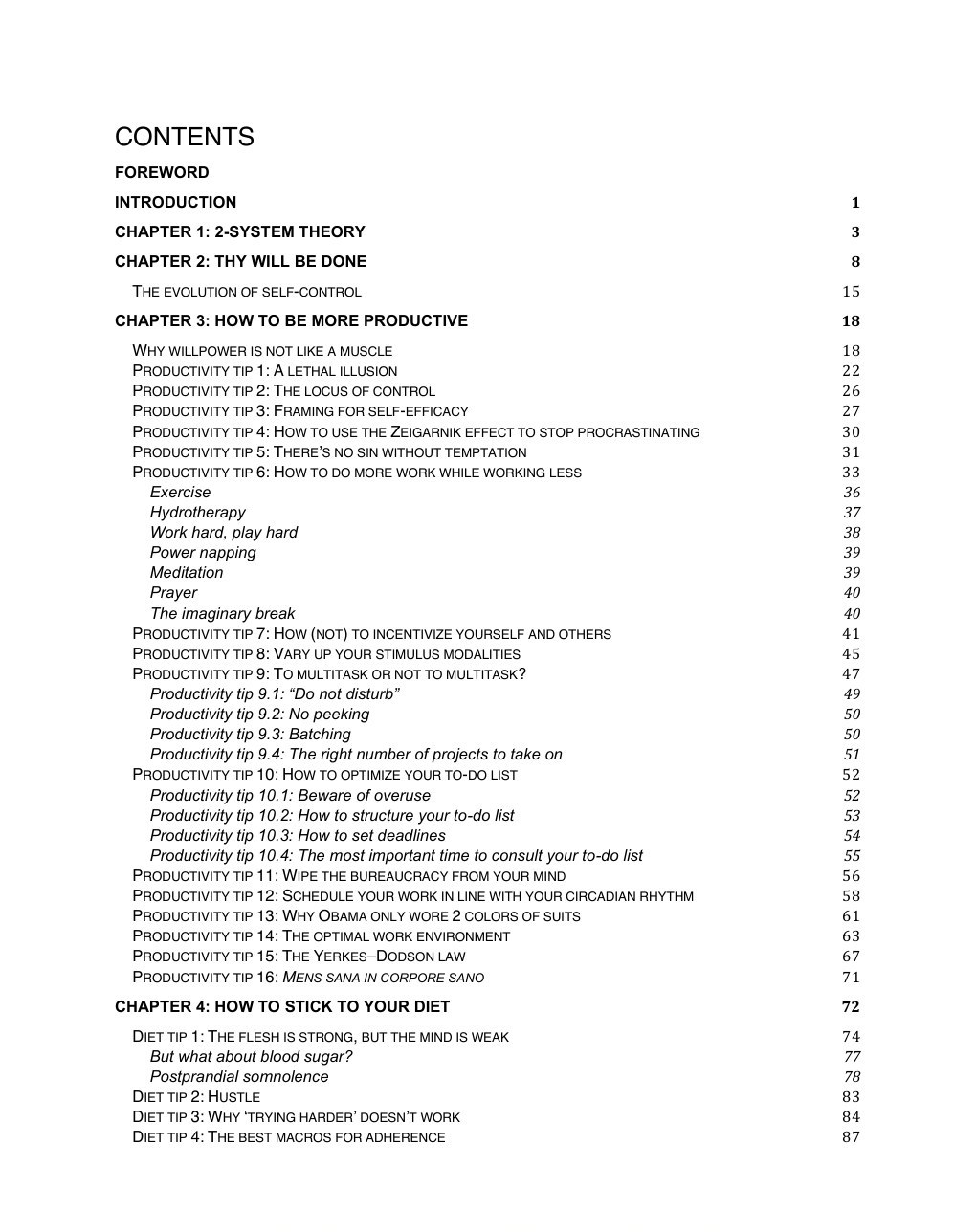
All 53 numbered tips across 6 chapters. Tap a chapter to expand it.
- The two systems of the mind
- Why willpower is what happens when they disagree
- The evolution of self-control
- Why willpower is not like a muscle
- Tip 1: A lethal illusion
- Tip 2: The locus of control
- Tip 3: Framing for self-efficacy
- Tip 4: How to use the Zeigarnik effect to stop
- Tip 5: There's no sin without temptation
- Tip 6: How to do more work while working less
- Work hard, play hard
- The imaginary break
- Tip 7: How (not) to incentivize yourself and others
- Tip 8: Vary up your stimulus modalities
- Tip 9: To multitask or not to multitask?
- 9.1: "Do not disturb"
- 9.2: No peeking
- 9.3: Batching
- 9.4: The right number of projects to take on
- Tip 10.1: Beware of overuse
- 10.2: How to structure your to-do list
- 10.3: How to set deadlines
- 10.4: The most important time to consult your to-do list
- Tip 11: Wipe the bureaucracy from your mind
- Tip 12: Schedule your work in line with your circadian rhythm
- Tip 13: Why Obama only wore 2 colors of suits
- Tip 14: The optimal work environment
- Tip 15: The Yerkes-Dodson law
- Tip 16: Mens sana in corpore sano
- Tip 1: The flesh is strong, but the mind is weak
- But what about blood sugar?
- Postprandial somnolence
- Tip 2: Hustle
- Tip 3: Why "trying harder" doesn't work
- Tip 4: The best macros for adherence
- Tip 5: How to interpret your personal preference
- Tip 6: How empty rewards can help us stick to our diet
- Tip 7: How not taking breaks can break your diet
- Tip 8: "Don't bind bacon to the cat's back"
- Tip 9: Make a meal plan
- Tip 10: Eat in line with your circadian rhythm
- Tip 11: Constant macros
- Tip 12: Projection bias
- Tip 13: Don't try to be a robot
- 13.1: Failure is a learning experience
- 13.2: Adopt a sustainable lifestyle perspective
- 13.3: View your calories as a budget
- 13.4: You don't always have to spend everything
- 13.5: Think outside the lunchbox
- Tip 14: How to stop food cravings
- 14.1: Mindfulness training
- 14.2: Episodic future thinking
- The forbidden fruit effect
- 14.3: How to teach yourself to like healthy, low-calorie foods
- Tip 15: How to cheat your diet
- 15.1: IIFYM
- 15.2: Think about food like an economist
- 15.3: Learn to prepare low-calorie comfort foods
- 15.4: How to fit indulgent cheat meals into your lifestyle
- 15.5: Eat out
- 15.6: Take a lesson from Japanese sushi etiquette
- Tip 16: Do this before every meal
- Tip 17: Do this after every meal
- Tip 18: How to manage your appetite
- 18.1: Eat more, not less
- 18.2: More protein, but not too much
- 18.3: How much fiber you need
- 18.4: Eat mindfully
- Tip 19: Minimize decision fatigue
- Tip 20: How to build activity habits
- Tip 21: Use action triggers
- Tip 22: How to change bad eating habits
- Tip 23: Get a standing desk
- Tip 24: Use availability effects
- Tip 25: The most useful skill that nobody regards as a skill
- 25.1: Shop satiated
- 25.2: Your grocery list is sacrosanct
- 25.3: Stay in the safe zones
- 25.4: How to organize your grocery list
- Tip 26: Umami preloads
- Tip 27: Learn how often to weigh yourself
- Tip 1: Use caffeine (more) strategically
- Tip 2: Listen to the right music
- Tip 3: Intra-workout drinks
- Tip 4: Optimize your training frequency
- Tip 5: Optimize your training intensity
- Tip 6: Use free weights
- What is motivation and how do we get it?
- Tip 1: Cultivate competence
- 1.1: Research
- 1.2: Tracking
- Tip 2: How to set goals
- Tip 3: How to become more autonomous
- Tip 4: Connect
- 4.1: Find a community
- 4.2: How purpose motivates us, even when it's nonsense
Loved by readers, coaches and athletes
If I could go back and give my younger self one book, this would be the one by a longshot. Whoever is reading this, do yourself a favor and pick up this book.
The takeaways and tips for being productive have already been implemented into my daily routine. I feel like I have all the tools and knowledge necessary to make sustainable lifestyle changes.
I have read a lot of "self help" books, and this is one of the best. Too many are devoid of effective information. This one breaks that trend with effective, research-backed information that helps you improve in a short time.
Full of super useful tips, very well written, with references to studies. I learned a lot, both about food behavior and training. A lot of myths have been gently eliminated and reviewed in a concrete way. This book is a must-have.
Always been a huge fan of all Menno's online training and nutrition related work, but this book is something else. All the science-based tips and tricks will definitely make my life even better.
I first heard of Menno years ago via Jeff Nippard, but his appearance on the Modern Wisdom podcast showed how multifaceted his knowledge is. Really glad I found this book, it's been the most actionable I've read in years.
I believe this book is easily worth over a thousand dollars
Most people spend hundreds on personal trainers, productivity courses and diet programs that ignore psychology and rely on motivation instead of giving you concrete tools. They treat the symptoms, not the cause.
So do the math. If the productivity advice alone increases your average lifetime income by 3%, over the next 20 years that's a net gain of:
Not to mention the value of being leaner, having less stress over your diet, and being happier. You can have all of that for less than the price of lunch.
Two types of people will read this page
Will think "this sounds interesting" and then scroll to something else. They'll bookmark this page "for later" and never come back. Six months from now, they'll still be stuck in the same cycle of broken promises.
Will recognize this as exactly what they've been looking for. They'll get the book, start implementing the strategies, and 30 days from now they'll be living proof that these methods work.
Which type are you?
How would you like to enjoy the book?
Pick a format, then your country. Digital is an instant download. Print ships from your local Amazon.
Download the book and try out the strategies. If you don't see real improvements in your productivity, diet adherence or self-control within 30 days, just email me and I'll refund every penny. No questions asked. You keep the files either way. Paperback and hardcover orders are handled by Amazon, so returns for those go through Amazon's own returns policy.

Hi, I'm Menno Henselmans
I'm a former business consultant turned international public speaker, scientific researcher and educator. My work has been published in over a dozen languages, and my website was ranked the #1 fitness website by The Huffington Post.
Since I graduated in behavioral economics at Warwick with a Master's degree with distinction, I've always been particularly interested in 3 things: fitness, happiness and productivity. This book ties those topics together under the theme of willpower, with a no-BS approach. My tips are as practical and concrete as possible.
More about MennoFrequently asked questions
Formats, delivery and whether this book is right for you.
Honestly, what are you still doing reading this page?
Go read my book. Until Monday 30 November, the ebook and audiobook are 50% off.
Get the bookGet it 50% off